


Recruiter Mode
Synergy Workspace Cover

Synergy

ROLE UX Design Intern
TEAM UX Interns Project Manager Mentor Buddy
TIMELINE 2026
SKILLS Product Design UX Strategy AI Interaction Design
Brief

How can we make the proposal-to-contract process as efficient as possible for telecom B2Bs?

The question we were asked was to reimagine the end-to-end proposal journey as one AI-assisted workspace, making manual coordination faster and enabling teams to handle more proposals.

Context

How does the Proposal generation process work?

Since I had never worked at a B2B Sales process, here's a map of how this works, in the simplest terms

THE FLOW OF PROPOSAL-TO-CONTRACT PROCESS
01.
Opportunity Identification
Step 1 Business Need Step 2 RFP Creation Step 3 RFP Publishing
02.
Discovery & Qualification
Step 4 Bid / No Bid Step 5 CRM Opportunity
03.
Solution & Proposal Development
Step 6 Proposal Planning Step 7 Proposal Drafting Step 8 Compliance Review
04.
Review & Approval
Step 9 Executive Approval Step 10 Proposal Submission
05.
Customer Engagement
Step 11 Customer Evaluation Step 12 Negotiation
06.
Contract Execution & Delivery
Step 13 Contract Signing

Dictionary:

RFP: An RFP (Request for Proposal) is a formal document a company or government agency creates to announce a new project and invite outside vendors to bid on doing the work
CRM (Customer Relationship Management): CRM stands for Customer Relationship Management. In simple words, it is a digital address book and organizer that helps a business keep track of all its customers and potential buyers in one place

Here's what we needed to do...

When I first read this problem statement I had chills, because this problem seemed so massive to solve

How might we reduce the 6–12 week proposal-to-contract cycle that proactively support teams through drafting, collaboration, approvals, and contract signing while keeping users in control of critical decisions?

It wasn't going to be easy, but we were ready for the challenge.

To make sense of the problem, we decided to focus on the person at the centre of it all: the Proposal Manager.

Research

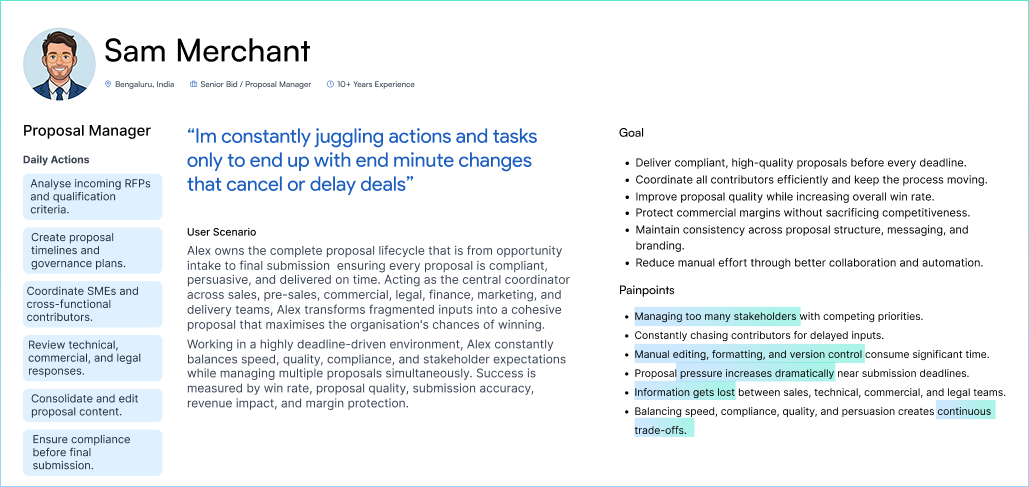
So, let's meet Sam, our Proposal Manager.

Imagine you're Sam. Here's how your day is...

Sam Merchant Persona
Sam Merchant Avatar

Sam Merchant

Bengaluru, India / Senior Bid / Proposal Manager / 10+ Years Experience
Proposal Manager
Daily Actions
Analyse incoming RFPs and qualification criteria.
Create proposal timelines and governance plans.
Coordinate SMEs and cross-functional contributors.
Review technical, commercial, and legal responses.
Consolidate and edit proposal content.
Ensure compliance before final submission.
“I'm constantly juggling actions and tasks only to end up with end minute changes that cancel or delay deals”
User Scenario

Sam owns the complete proposal lifecycle that is from opportunity intake to final submission ensuring every proposal is compliant, persuasive, and delivered on time. Acting as the central coordinator across sales, pre-sales, commercial, legal, finance, marketing, and delivery teams, Sam transforms fragmented inputs into a cohesive proposal that maximises the organisation's chances of winning.

Working in a highly deadline-driven environment, Sam constantly balances speed, quality, compliance, and stakeholder expectations while managing multiple proposals simultaneously. Success is measured by win rate, proposal quality, submission accuracy, revenue impact, and margin protection.

Goal
Deliver compliant, high-quality proposals before every deadline. Coordinate all contributors efficiently and keep the process moving. Improve proposal quality while increasing overall win rate. Protect commercial margins without sacrificing competitiveness. Maintain consistency across proposal structure, messaging, and branding. Reduce manual effort through better collaboration and automation.
Painpoints
Managing too many stakeholders with competing priorities. Constantly chasing contributors for delayed inputs. Manual editing, formatting, and version control consume significant time. Proposal pressure increases dramatically near submission deadlines. Information gets lost between sales, technical, commercial, and legal teams. Balancing speed, compliance, quality, and persuasion creates continuous trade-offs.
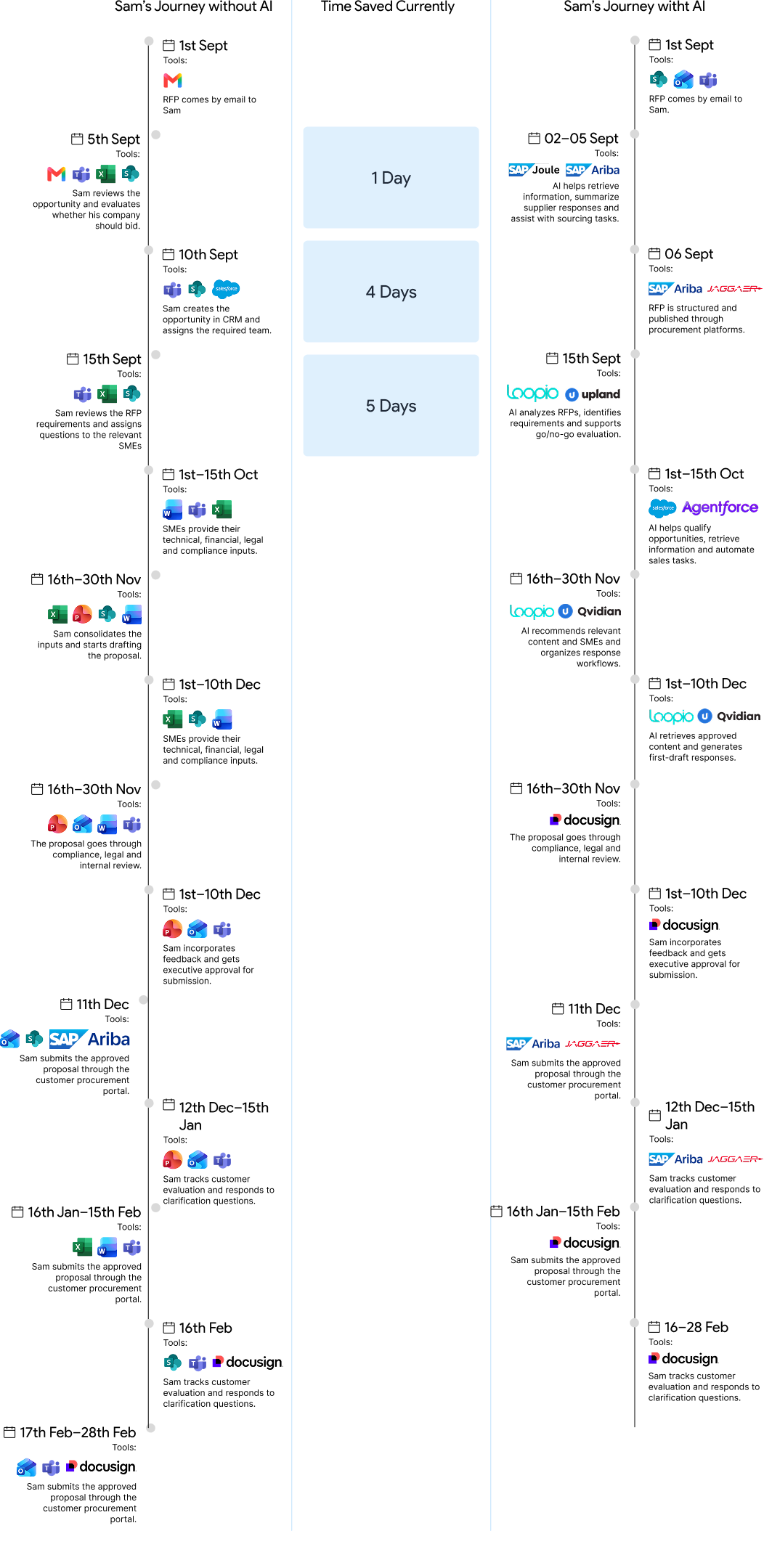
Time Saved Currently

Here’s Sam’s journey to making successful deals

Before we started building our solution, we wanted to understand how much time existing AI tools in the market were actually saving.

Sam's Journey Time Saved Analysis Composition Insight

Based on this we realised even if AI tools existed they made the process fragmented and did not increase efficiency significantly

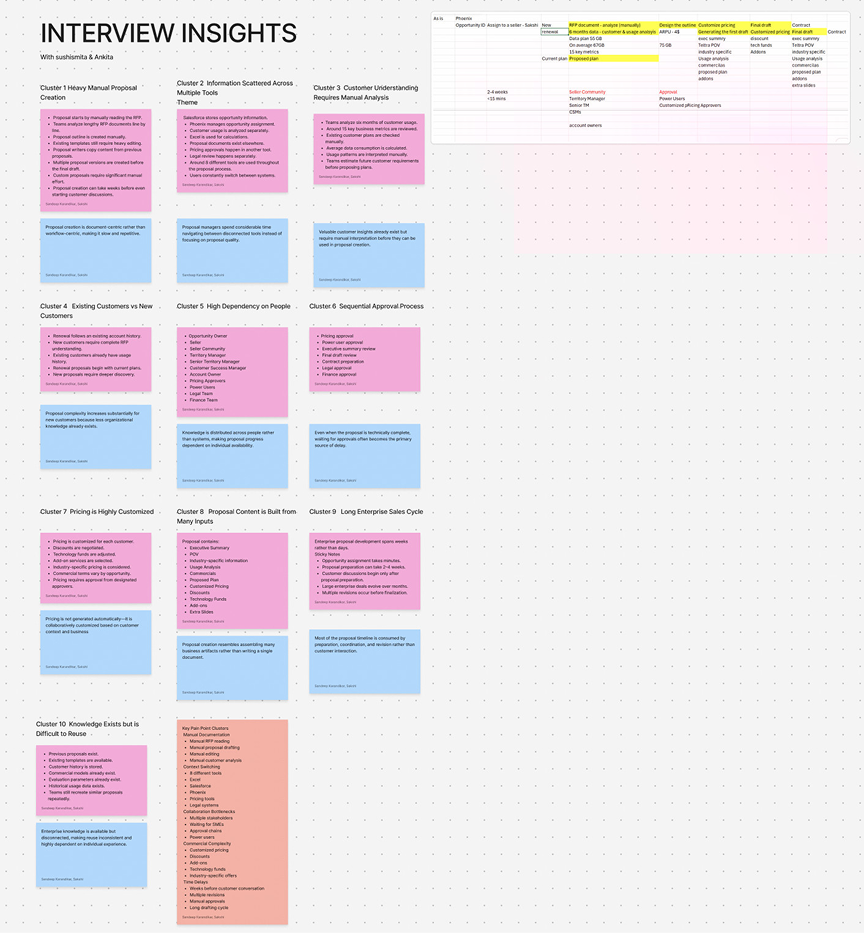
Interview Insights

After this, we spoke to stakeholders who had used these tools to gain a deeper understanding of their experiences.

We wanted to understand the pain points people faced, both online and offline.

Interview Insights Overview Insight

Proposal managers spend considerable time navigating between disconnected tools instead of focusing on proposal quality.

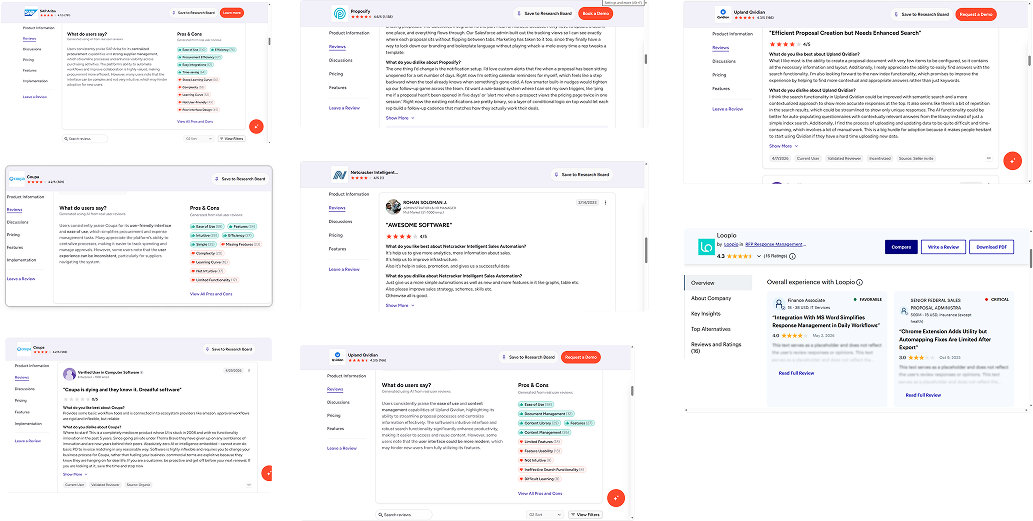
We checked websites like g2.com to see feedback

G2 Reviews Feedback Overview
Pain Points

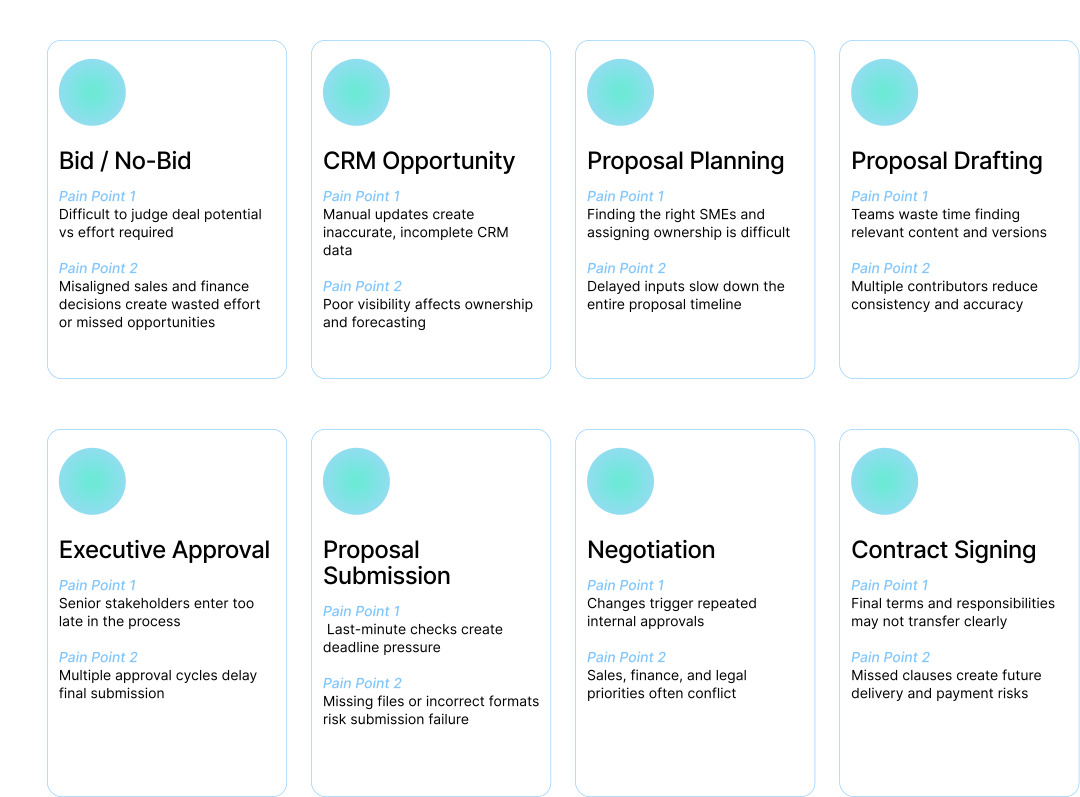
Based on all this research we tried to map out all the pain points collectively

We tried to understand what things we needed to do to make this an effective solution

Pain Points Map
Bid / No-Bid
Pain Point 1
Difficult to judge deal potential vs effort required
Pain Point 2
Misaligned sales and finance decisions create wasted effort or missed opportunities
CRM Opportunity
Pain Point 1
Manual updates create inaccurate, incomplete CRM data
Pain Point 2
Poor visibility affects ownership and forecasting
Proposal Planning
Pain Point 1
Finding the right SMEs and assigning ownership is difficult
Pain Point 2
Delayed inputs slow down the entire proposal timeline
Proposal Drafting
Pain Point 1
Teams waste time finding relevant content and versions
Pain Point 2
Multiple contributors reduce consistency and accuracy
Executive Approval
Pain Point 1
Senior stakeholders enter too late in the process
Pain Point 2
Multiple approval cycles delay final submission
Proposal Submission
Pain Point 1
Last-minute checks create deadline pressure
Pain Point 2
Missing files or incorrect formats risk submission failure
Negotiation
Pain Point 1
Changes trigger repeated internal approvals
Pain Point 2
Sales, finance, and legal priorities often conflict
Contract Signing
Pain Point 1
Final terms and responsibilities may not transfer clearly
Pain Point 2
Missed clauses create future delivery and payment risks
Solution Statement

“An end-to-end AI co-pilot for bid managers, unifying opportunity intake, drafting, compliance, negotiation and signature into one governed workflow.”

Solution

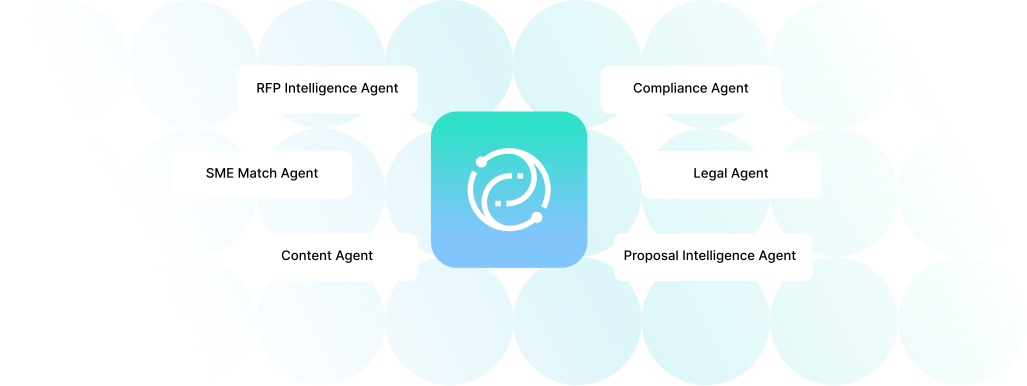
Introducing Synergy

An adaptive AI workspace built around the way Sam actually works.
Synergy connects the proposal journey from opportunity identification to contract signing, bringing the right information, people and AI agents into the workflow when they're needed.

Introducing Synergy Illustration
Solution

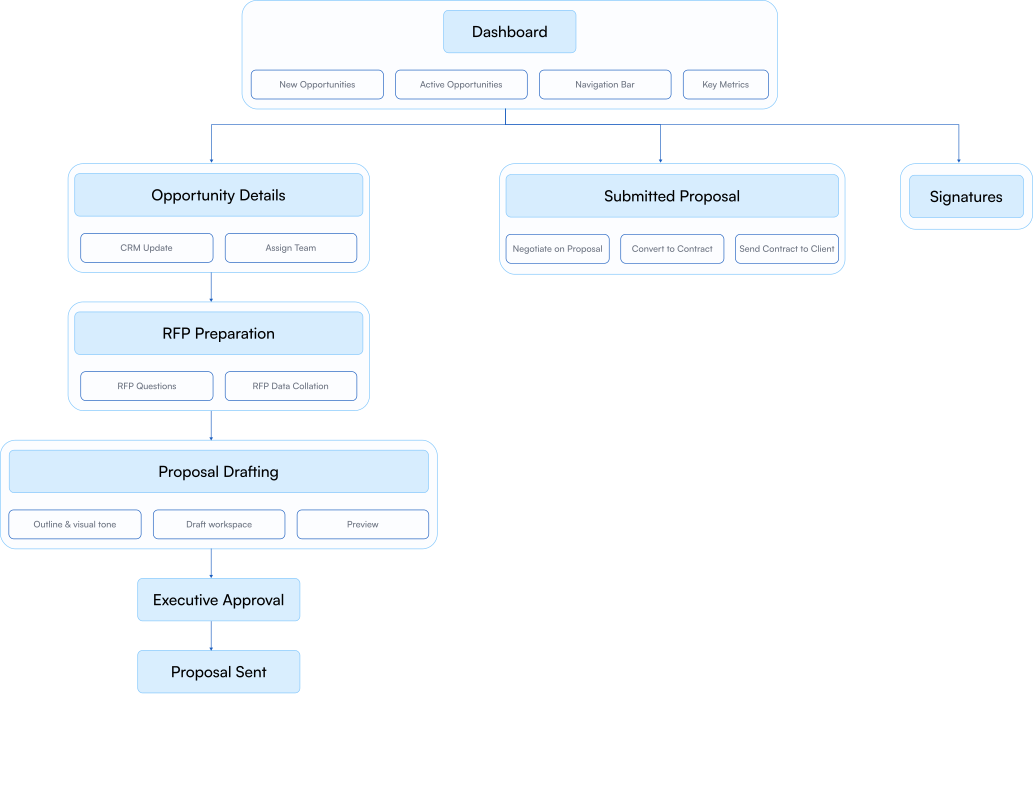
Information Architecture

We mapped Sam's journey from opportunity to contract and grouped his scattered tasks into a few focused workspaces. Instead of replicating the tools he already uses, the IA follows how he actually works, with the Dashboard acting as the central entry point and the workflow branching naturally after proposal submission.

Information Architecture Diagram
Solution

How Synergy adapts to Sam's workflow

Now, let's walk through the proposal process with Sam and see how Synergy supports him at each step.

Sam with Laptop Illustration
Solution

Let's start with the Dashboard

Sam identifies and qualifies a new opportunity, reviews its potential, requirements and risks, and decides whether to pursue it. The opportunity is then structured in the CRM with key deal information and ownership. Sam builds the proposal team by assigning relevant SMEs, sends them the RFP, and brings their inputs together with relevant existing content to build the proposal.
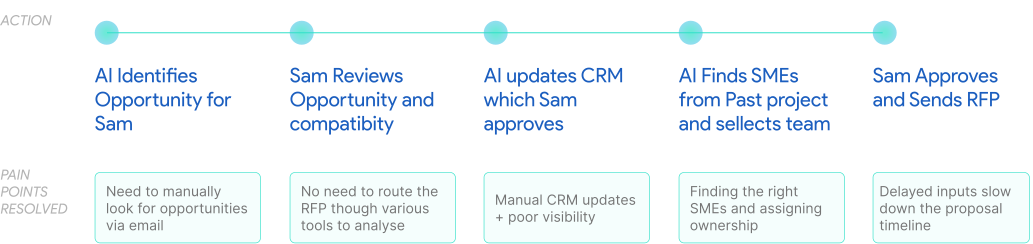
Dashboard Action Strip
ACTION PAIN POINTS RESOLVED
AI Identifies Opportunity for Sam
Sam Reviews Opportunity and compatibility
AI updates CRM which Sam approves
AI Finds SMEs from Past project and selects team
Sam Approves and Sends RFP
Need to manually look for opportunities via email
No need to route the RFP through various tools to analyse
Manual CRM updates + poor visibility
Finding the right SMEs and assigning ownership
Delayed inputs slow down the proposal timeline
Solution

RFP Preparation

Teams contribute their inputs while relevant content and previous proposals are brought together to build the response.

ACTION PAIN POINTS RESOLVED
AI identifies questions that need input from different teams
Sam reviews and selects the questions to raise
AI sends questions to the relevant teams and collects responses
Sam reviews and approves SME inputs
AI consolidates inputs for proposal drafting
Manually identifying required teams
Tracking questions and responses
Delayed SME inputs
Manually consolidating inputs
Missing or incomplete responses
RFP Preparation Video Slot
Solution

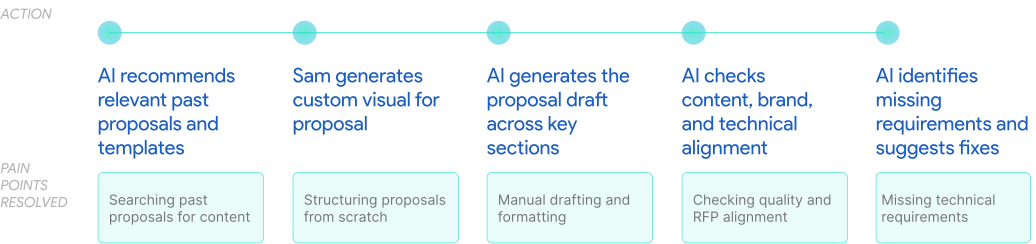
Proposal Planning

Teams contribute their inputs while relevant content and previous proposals are brought together to build the response.

Proposal Planning Action Strip
ACTION PAIN POINTS RESOLVED
AI recommends relevant past proposals and templates
Sam generates custom visual for proposal
AI generates the proposal draft across key sections
AI checks content, brand, and technical alignment
AI identifies missing requirements and suggests fixes
Searching past proposals for content
Structuring proposals from scratch
Manual drafting and formatting
Checking quality and RFP alignment
Missing technical requirements
Solution

Executive Approval

Teams contribute their inputs while relevant content and previous proposals are brought together to build the response.

ACTION PAIN POINTS RESOLVED
Sam opens the completed proposal
AI sends the proposal for executive review
Executive receives a review request with an auto-reminder
Executive reviews and approves the proposal
Sam shares the approved proposal for submission
Senior stakeholders enter too late in the process
Multiple approval cycles delay submission
Solution

Negotiation

Teams contribute their inputs while relevant content and previous proposals are brought together to build the response.

ACTION PAIN POINTS RESOLVED
Sam starts a live negotiation session
AI captures the client's position and compares it
AI identifies negotiation risks and recommends a counter
Sam approves the suggested counter
AI updates the pricing and commercial terms
Changes trigger repeated internal approvals
Sales, finance, and legal priorities often conflict
Final terms and responsibilities may not transfer clearly
Solution

Contract Generation

Teams contribute their inputs while relevant content and previous proposals are brought together to build the response.

ACTION PAIN POINTS RESOLVED
Sam opens the negotiated proposal
AI drafts the contract from agreed terms
Sam requests a commercial change
AI updates and highlights the change
Sam approves and reviews the final version
Repeated contract approvals
Missed clauses & risks
Solution

Contract Signing

Teams contribute their inputs while relevant content and previous proposals are brought together to build the response.

ACTION PAIN POINTS RESOLVED
Sam reviews the final contract
Sam checks the required signatories
AI tracks signing status
AI drafts and sends the signing email
Sam monitors pending signatures
Repeated follow-ups with signatories
Missed clauses & signing risks
Learnings

AI needs context to be useful.

I learned that good AI experiences depend on giving AI the right information, not just adding AI to an existing workflow.

Research changed the direction of the product.

Talking to stakeholders helped me move beyond assumptions and design around real workflow pain points.

Good IA can make complex systems feel simple.

Mapping the journey first helped me turn a fragmented, multi-tool process into one connected experience.

The goal isn't to automate everything.

The most valuable opportunities were often about reducing coordination, searching and follow-ups while keeping Sam in control.